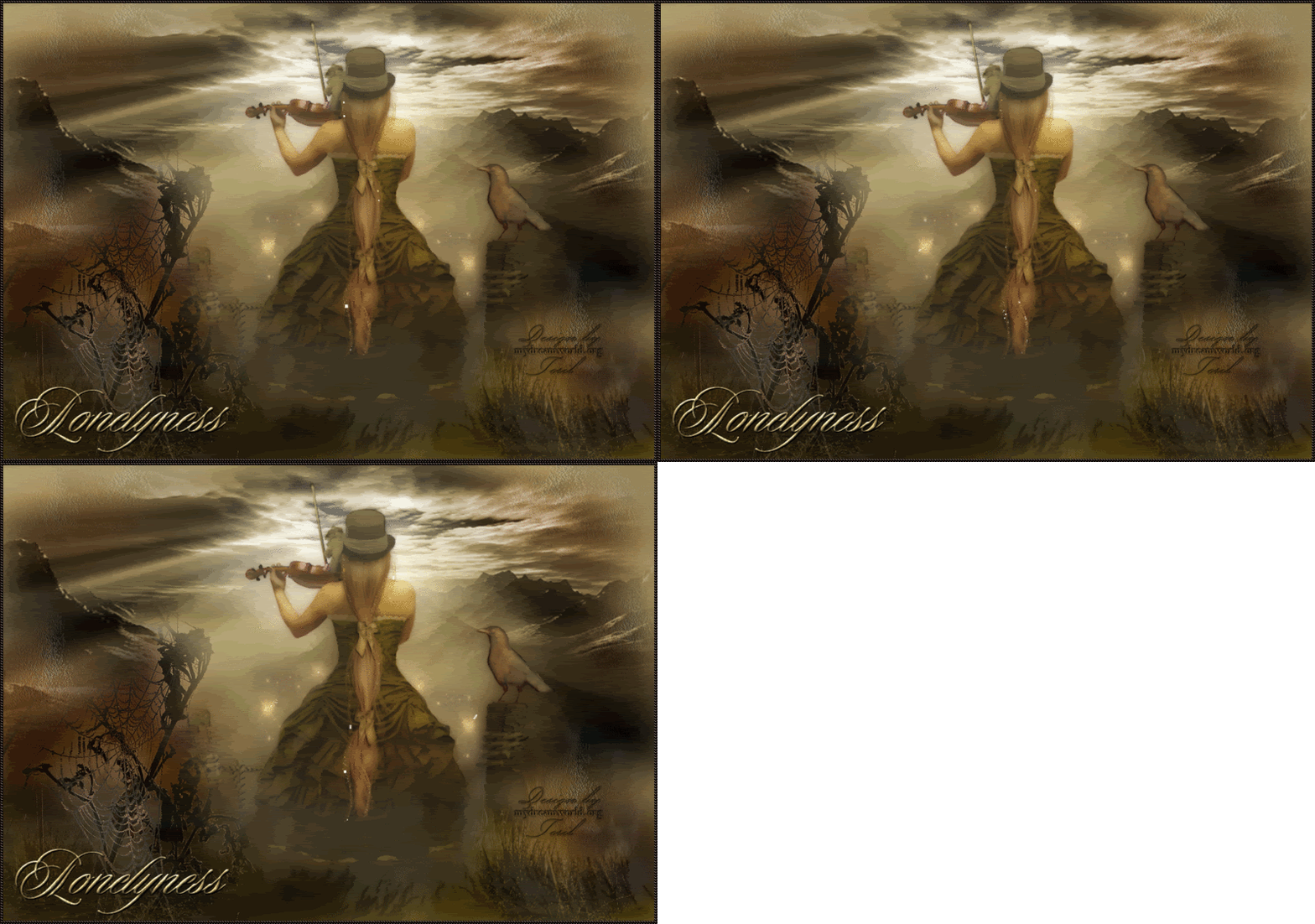
|
The Lady of Shalott
by Lord
Alfred Tennyson
Part I
On either side the river
lie
Long fields of barley and of rye,
That clothe the wold and meet the
sky;
And through the field the road runs by
To many-towered
Camelot;
And up and down the people go,
Gazing where the lilies
blow
Round an island there below,
The island of Shalott.
Willows whiten, aspens
quiver,
Little breezes dusk and shiver
Through the wave that runs for
ever
By the island in the river
Flowing down to Camelot.
Four grey
walls, and four grey towers,
Overlook a space of flowers,
And the silent
isle imbowers
The Lady of Shalott.
By the margin,
willow-veiled,
Slide the heavy barges trailed
By slow horses; and
unhailed
The shallop flitteth silken-sailed
Skimming down to
Camelot:
But who hath seen her wave her hand?
Or at the casement seen her
stand?
Or is she known in all the land,
The Lady of Shalott?
Only reapers, reaping early
In
among the bearded barley,
Hear a song that echoes cheerly
From the river
winding clearly,
Down to towered Camelot:
And by the moon the reaper
weary,
Piling sheaves in uplands airy,
Listening, whispers "'Tis the
fairy
Lady of Shalott."
Part II
There she weaves by night and
day
A magic web with colours gay.
She has heard a whisper say,
A curse
is on her if she stay
To look down to Camelot.
She knows not what the
curse may be,
And so she weaveth steadily,
And little other care hath
she,
The Lady of Shalott.
And moving through a mirror
clear
That hangs before her all the year,
Shadows of the world
appear.
There she sees the highway near
Winding down to Camelot:
There
the river eddy whirls,
And there the surly village-churls,
And the red
cloaks of market girls,
Pass onward from Shalott.
Sometimes a troop of damsels
glad,
An abbot on an ambling pad,
Sometimes a curly shepherd-lad,
Or
long-haired page in crimson clad,
Goes by to towered Camelot;
And
sometimes through the mirror blue
The knights come riding two and two:
She
hath no loyal knight and true,
The Lady of Shalott.
But in her web she still
delights
To weave the mirror's magic sights,
For often through the silent
nights
A funeral, with plumes and lights
And music, went to Camelot:
Or
when the moon was overhead,
Came two young lovers lately wed;
"I am half
sick of shadows," said
The Lady of Shalott.
Part III
A bow-shot from her
bower-eaves,
He rode between the barley-sheaves,
The sun came dazzling
through the leaves,
And flamed upon the brazen greaves
Of bold Sir
Lancelot.
A red-cross knight for ever kneeled
To a lady in his
shield,
That sparkled on the yellow field,
Beside remote
Shalott.
The gemmy bridle glittered
free,
Like to some branch of stars we see
Hung in the golden
Galaxy.
The bridle bells rang merrily
As he rode down to Camelot:
And
from his blazoned baldric slung
A mighty silver bugle hung,
And as he rode
his armour rung,
Beside remote Shalott.
All in the blue unclouded
weather
Thick-jewelled shone the saddle-leather,
The helmet and the
helmet-feather
Burned like one burning flame together,
As he rode down to
Camelot.
As often through the purple night,
Below the starry clusters
bright,
Some bearded meteor, trailing light,
Moves over still
Shalott.
His broad clear brow in sunlight
glowed;
On burnished hooves his war-horse trode;
From underneath his
helmet flowed
His coal-black curls as on he rode,
As he rode down to
Camelot.
From the bank and from the river
He flashed into the crystal
mirror,
"Tirra lirra," by the river
Sang Sir Lancelot.
She left the web, she left the
loom,
She made three paces through the room,
She saw the water-lily
bloom,
She saw the helmet and the plume,
She looked down to
Camelot.
Out flew the web and floated wide;
The mirror cracked from side
to side;
"The curse is come upon me," cried
The Lady of
Shalott.
Part IV
In the stormy east-wind
straining,
The pale yellow woods were waning,
The broad stream in his
banks complaining,
Heavily the low sky raining
Over towered
Camelot;
Down she came and found a boat
Beneath a willow left
afloat,
And round about the prow she wrote
The Lady of
Shalott.
And down the river's dim
expanse,
Like some bold seer in a trance
Seeing all his own
mischance,
With a glassy countenance
Did she look to Camelot.
And at
the closing of the day
She loosed the chain, and down she lay;
The broad
stream bore her far away,
The Lady of Shalott.
Lying, robed in snowy
white
That loosely flew to left and right -
The leaves upon her falling
light -
Through the noises of the night
She floated down to
Camelot:
And as the boat-head wound along
The willowy hills and fields
among,
They heard her singing her last song,
The Lady of
Shalott.
Heard a carol, mournful,
holy,
Chanted loudly, chanted lowly,
Till her blood was frozen
slowly,
And her eyes were darkened wholly,
Turned to towered
Camelot.
For ere she reached upon the tide
The first house by the
water-side,
Singing in her song she died,
The Lady of
Shalott.
Under tower and balcony,
By
garden-wall and gallery,
A gleaming shape she floated by,
Dead-pale
between the houses high,
Silent into Camelot.
Out upon the wharfs they
came,
Knight and burgher, lord and dame,
And round the prow they read her
name,
The Lady of Shalott.
Who is this? and what
is here?
And in the lighted palace near
Died the sound of royal
cheer;
And they crossed themselves for fear,
All the knights at
Camelot:
But Lancelot mused a little space;
He said, "She has a lovely
face;
God in his mercy lend her grace,
The Lady of
Shalott."
by H. W. Longfellow Rating: 4.41
Votes: 22
I shot an arrow into the air,
It fell to earth, I knew not
where;
For, so swiftly it flew, the sight
Could not follow it in its
flight.
I breathed a song into the air,
It fell to earth, I knew not
where;
For who has sight so keen and strong,
That it can follow the flight
of song?
Long, long afterward, in an oak
I found the arrow, still
unbroke;
And the song, from beginning to end,
I found again in the heart
of a friend.
beautiful artwork
by:
|